
The vericoding toolchain

Contracts are the single source of semantic truth. You write them once as plain Python; the same artifact runs as a test today and lowers to a Coq proof obligation tomorrow. The gradient is BDD → executable contracts → mechanised proof, and each rung is useful on its own.

specsaver

Specification-driven verification. Contracts — preconditions, postconditions, invariants, frame conditions, and exception exits — written as plain Python functions and organised by entry point. The contract language is the single source of semantic truth from which every test and proof artefact is derived.

  • Contracts are executable — the same predicate that documents a guarantee enforces it at runtime.
  • Gherkin traceability — each contract binds to the When clause it came from.
  • Lowers to proof obligations — introspected into Coq (Snakelet / FunSpecS) and scored PROVED / DISPROVED / UNKNOWN.
View on GitHub →

axiomander

Mechanised proof for vanilla Python. Contracts are plain assert statements — no imports, no decorators. A Coq + SMT pipeline proves properties; an LLM oracle handles the rest. Zero runtime overhead under python -O.

  • No new language — assert statements, type annotations, and Dafny-style ghost state in plain Python.
  • Coq + SMT + LLM — wp_prove + lia clears most goals, z3 / cvc4 handle the rest, an LLM oracle finishes.
  • MCP-native — check-file, check-function, verify-function, frame-report, and more from any MCP client.
View on GitHub →

rocq-piler

An MCP-based proof assistant for Rocq. Hash-addressed goals, coq-lsp-authoritative state, and parallel goal closure let frontier LLMs discharge real theorems — PCF type preservation for $0.06.

  • Hash-addressed goals — target any open goal by hash and work them in any order.
  • coq-lsp state — the prover always sees what Rocq actually believes.
  • Parallel goal closure — batch-apply tactics to whole classes of goals.
View on GitHub →

Vericoding Services

Prove what the program does. Then make it faster.

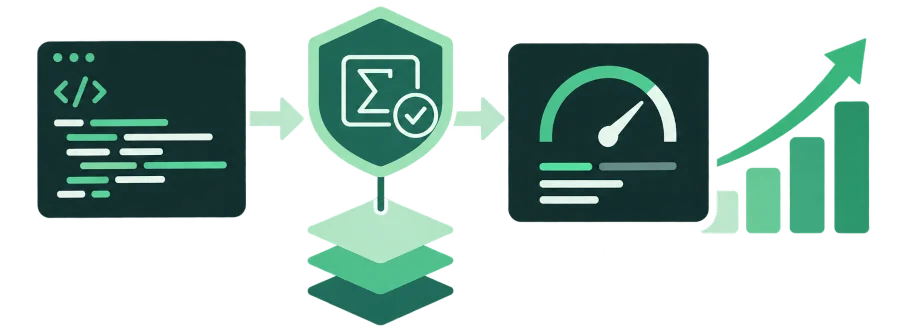
Models now write more code than you can review line by line. You specify what the program must do. We prove the implementation meets that specification, and where latency or compute cost is the problem, we replace it with a faster program that still does.

See the services
Code checked by a proof, then measured for speed

Latest from the blog

View all posts →
AI-Guided Certified Program Refinement

AI-Guided Certified Program Refinement

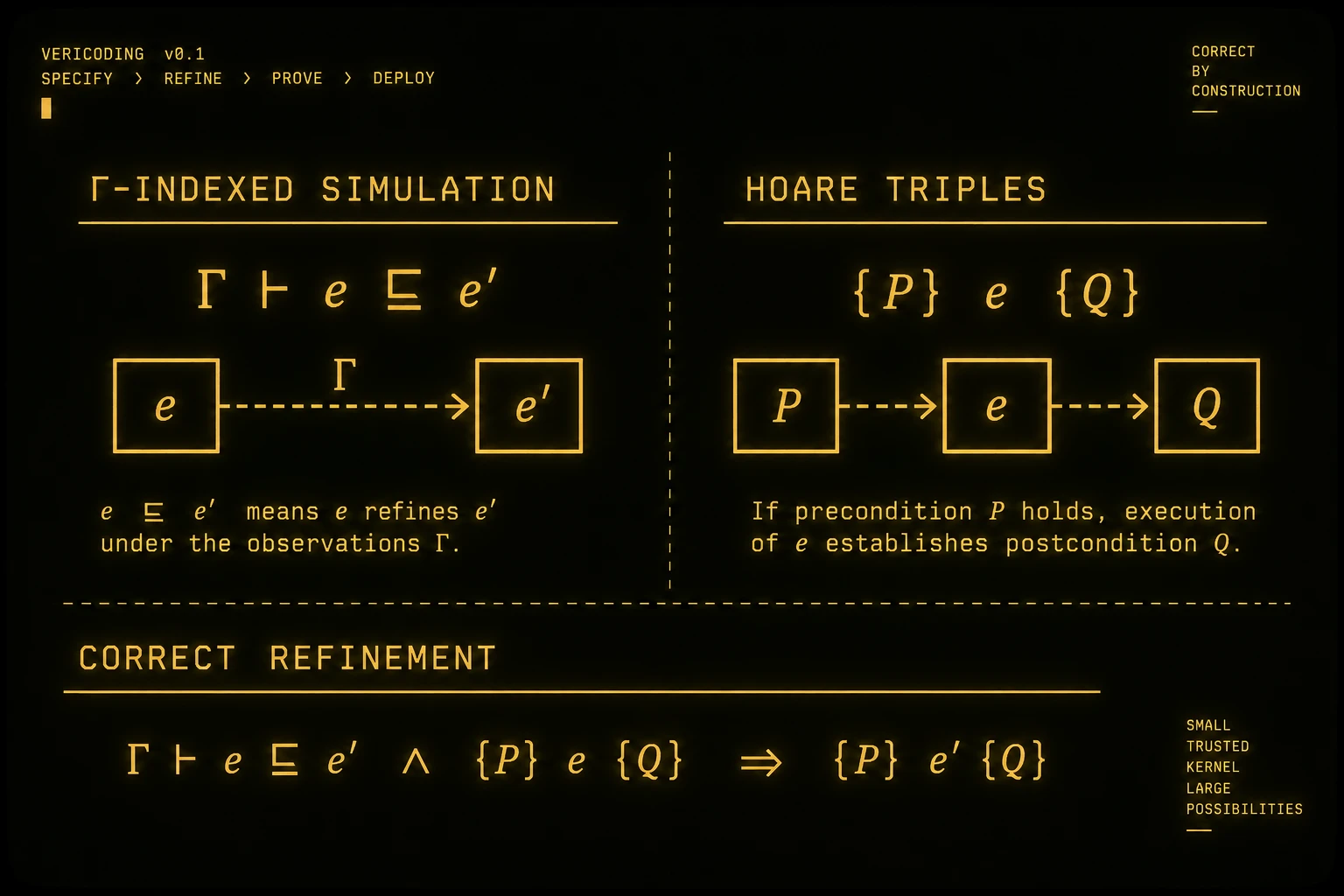
Software's core problem is knowing what it should do. AI-guided certified program refinement — vericoding — makes specification the artefact we tinker with, and lets AI guess program transformations that a theorem prover certifies.


From Vibecoding to Vericoding: A Gradient, Not a Jump

From Vibecoding to Vericoding: A Gradient, Not a Jump

You do not have to go from zero to verified in one step. You can start with Gherkin scenarios, graduate to executable contracts with specsaver, and then bring in a theorem prover when you are ready. Contracts are the bridge.